You’ve been going back and forth for an hour. Should I send the text? Should I take the job? Should I go out tonight or stay home? Every time you pick a side, a new “but” shows up.
If that sounds familiar, you’re not bad at deciding. You’re stuck on a choice with two reasonable answers, and more thinking won’t make one of them obviously right. This guide gives you a simple five-step way to decide, in about ten minutes.
Why Should I or Should I Not? Feels So Hard
Most yes or no decisions feel hard for three reasons:
- Both options look good. When two choices are close, your brain keeps hunting for a tiebreaker that doesn’t exist.
- Fear of regret. You picture the worst outcome of each choice and freeze.
- Too much information. More research often adds noise instead of clarity.
The good news is that for most everyday decisions, the gap between the two options is smaller than it feels.
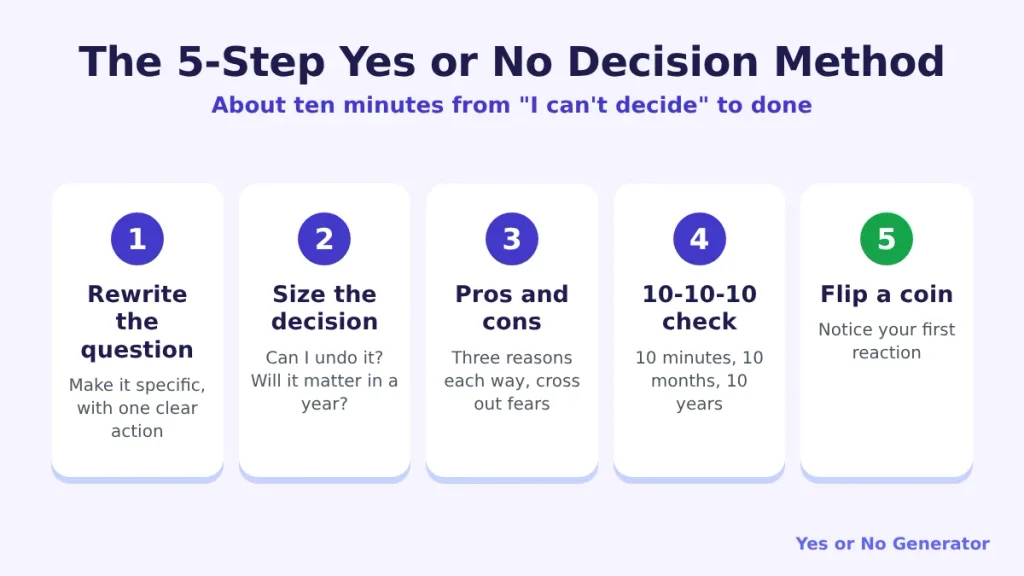
Step 1: Rewrite the Question
A vague question gets a vague answer. Turn “Should I change careers?” into something you can actually answer, like “Should I apply for the marketing role this week?”
Make the question specific, add a time frame, and make sure “yes” means one clear action.
Step 2: Size the Decision
Ask yourself two quick questions:
- Can I undo it? Sending a text, trying a class, or buying a $20 item is easy to reverse. Moving across the country is not.
- Will it matter in a year? If the honest answer is “barely,” decide fast.
Small, reversible choices deserve a quick answer. Big, hard-to-undo choices deserve more time and advice from real people.
Step 3: Make a Short Pros and Cons List
Set a timer for five minutes. Write three reasons to say yes and three to say no. Then cross out anything that is only a fear (“what if they laugh at me?”) and keep what is likely and real.
If one side clearly has stronger reasons, you have your answer. If the two sides look equal, move on to the next step.
Step 4: Try the 10-10-10 Check
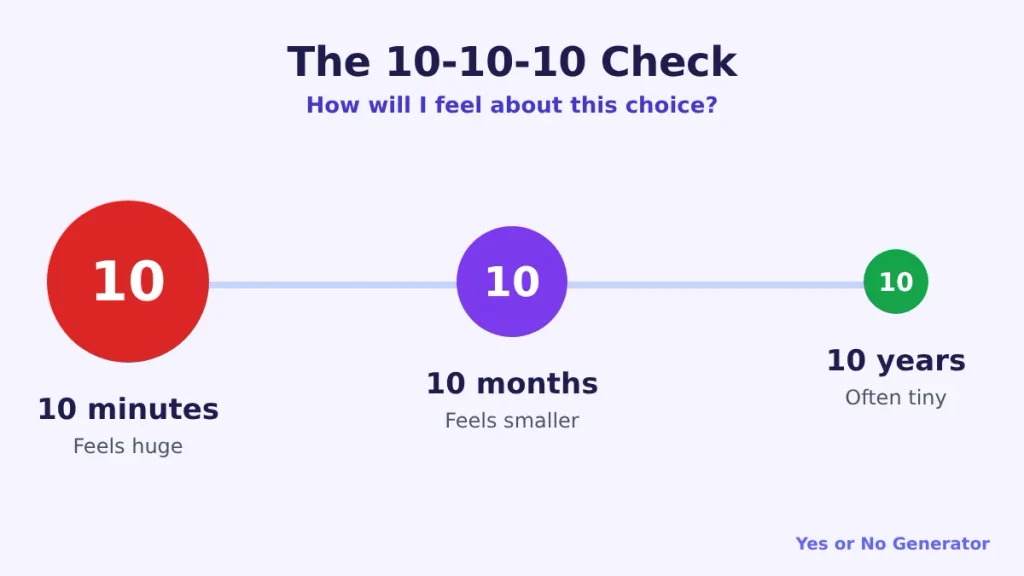
Ask how you will feel about each choice in 10 minutes, 10 months, and 10 years.
Many choices feel huge in the first 10 minutes and tiny after that. If both options look fine in 10 years, the stakes are low, and it’s time to stop overthinking.
Step 5: Flip a Coin to Hear Your Gut Feeling
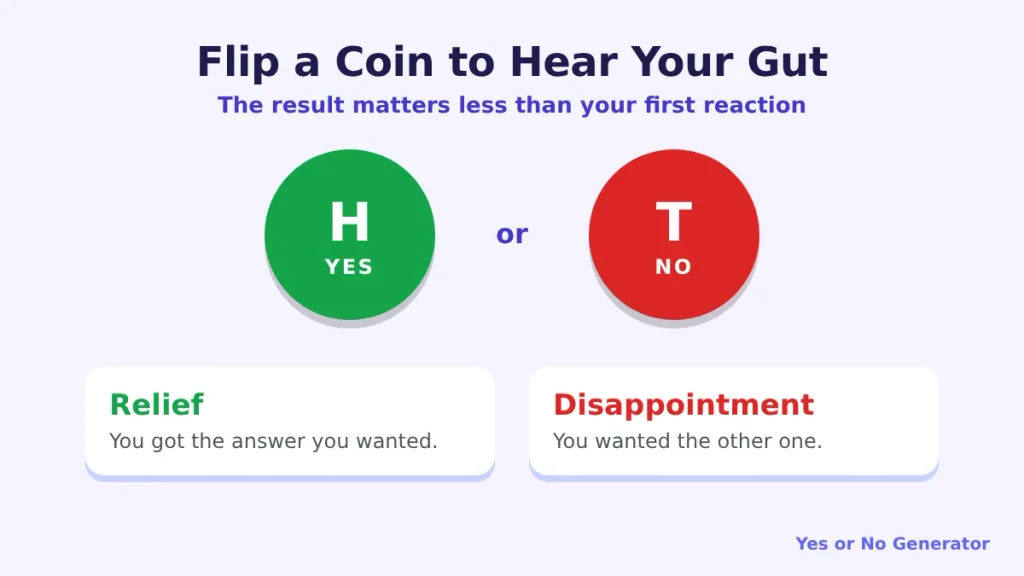
Give “yes” to heads and “no” to tails, then flip. The point isn’t to obey the coin. The point is to notice how you feel in the first second after it lands.
- Relief means you got the answer you wanted.
- Disappointment means you wanted the other one.
Your reaction is the real answer. The coin just helped you hear it.
There is some research behind the idea. In a study by economist Steven Levitt, people who were undecided about real-life choices flipped a coin online. Those who got heads were about 25 percent more likely to make a change, and people who made a change reported being happier six months later. The participants chose to join and rated their own happiness, so treat the result as a hint, not proof. You can read the summary from the National Bureau of Economic Research.
You don’t need a coin in your pocket. Press our yes or no button, roll the yes or no dice, or spin the yes or no wheel.
Real Examples
Here is how the steps work on common questions.
“Should I text them first?” This is low stakes and easy to undo. Ask which you would regret more: sending it or never knowing. For ideas on what to say next, see our 100 yes or no questions to ask your crush.
“Should I go to the party?” If you’re tired but usually enjoy these events, say yes and give yourself permission to leave after an hour.
“Should I buy it?” Wait 24 hours. If you still want it tomorrow and it fits your budget, buy it.
“Should I quit my job?” This is a big decision. Don’t leave it to a random answer. Look at your savings, talk to someone you trust, and give yourself a deadline.
When Not to Use a Random Answer
A random answer is fine for small, low-risk choices. Skip it for health, money, legal, safety, and major relationship decisions. For those, use real facts and talk to a qualified professional or a person you trust.
If you like a more playful nudge for lighter questions, try our free yes or no tarot reading. It is for fun and reflection only.
Frequently Asked Questions
How do I stop overthinking a yes or no decision?
Set a ten-minute timer, use the steps above, and decide when it ends. Extra time rarely brings new information.
What if I regret my choice?
Most everyday choices can be adjusted later. Treat a regret as information for next time, not as proof that you failed.
Is it okay to let a coin decide?
For small decisions, yes. For big ones, use it only as a gut check, then rely on facts and advice.
What if my answer is “maybe”?
Find the one missing piece of information that would tip the choice, get it, and set a deadline to decide.
Final Thoughts
When you can’t decide between “I should” and “I should not,” the problem is usually not the lack of an answer. It’s the pressure to find the perfect one. Make the question clear, check the stakes, compare your reasons, and listen to your reaction.
Still stuck? Press the yes or no button and notice how you feel about the answer.